
How to Evaluate PCR Resin Quality: A Technical Guide for Packaging Teams
Elina Nousia | 14/07/2026
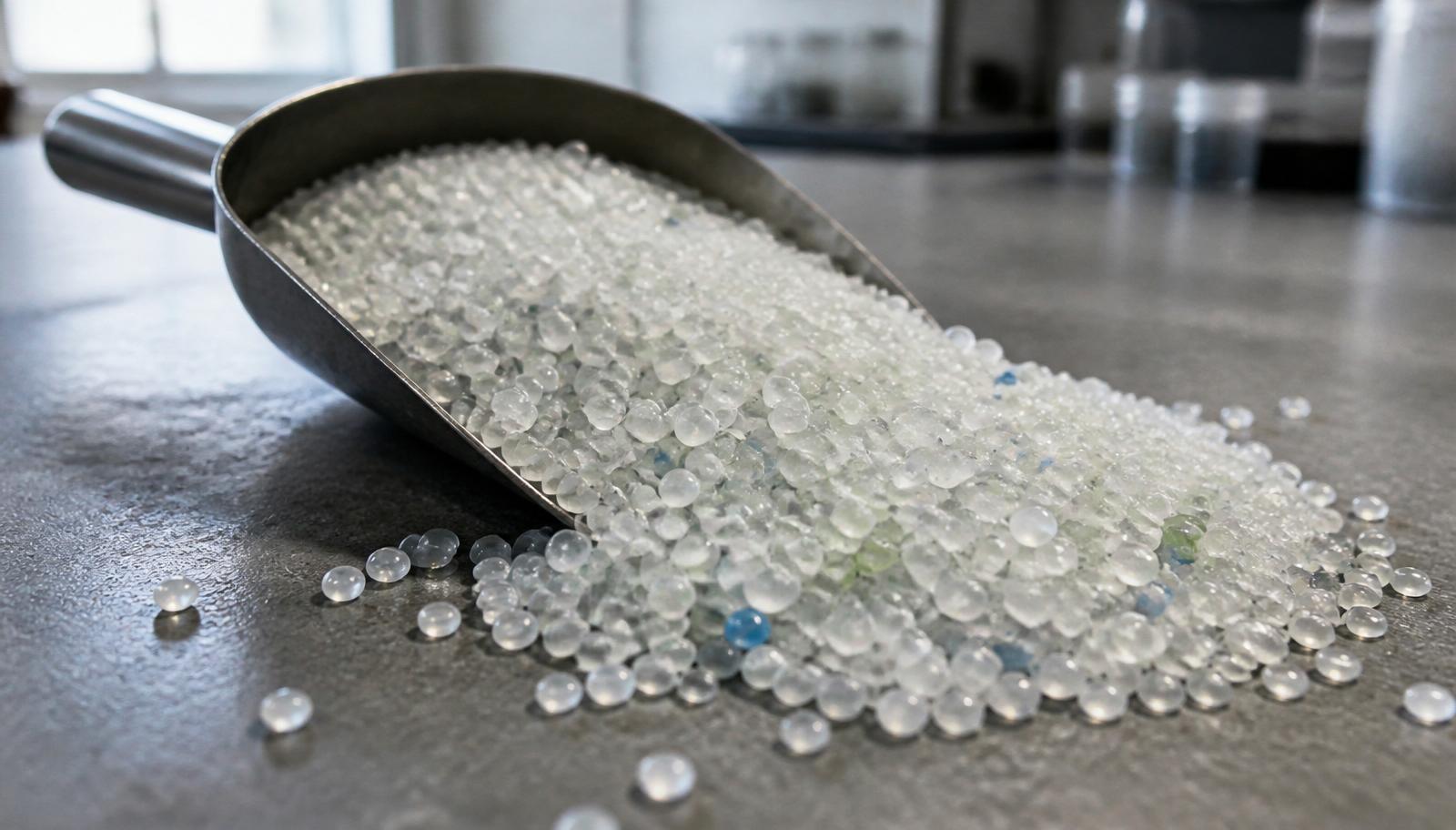
Recycled plastic packaging is no longer a nice-to-have. EU regulation, brand commitments, and consumer expectations are all pushing packaging teams to design with post-consumer recycled (PCR) resin at meaningful percentages. The bottleneck is rarely intent. It's confidence. How do you know a given lot of PCR will run on your lines, hit your color, and hold up in the market?
This guide walks through Resycure's Material Intelligence framework for qualifying PCR resin: how to move from a supplier's Technical Data Sheet (TDS) to a performance-based specification you can actually enforce.
Why generic TDS review is not enough
A TDS tells you what a supplier aims to deliver on a typical lot. For virgin resin that is usually enough, because the process is tightly controlled and lot-to-lot variation is small. PCR is different: feedstock composition shifts with the collection stream, sorting yield, and washing line performance. Two lots with the same TDS values can behave very differently on a blow-molder or an injection tool.
Packaging teams that qualify PCR on TDS alone tend to see the same failure modes repeat:
- Color drift between lots, forcing rework at the masterbatch stage
- Stress cracking in finished bottles weeks after filling
- Odor complaints in personal care and home care applications
- Process instability: melt temperature, screw torque, or cycle time creeping outside the control window
Every one of these is expensive, and every one is avoidable with the right qualification workflow.
The Material Intelligence framework
Material Intelligence is a four-step qualification loop that treats each PCR lot as a data point, not a document.
1. TDS triage
Start with the TDS, but read it critically. For rPET the non-negotiables are intrinsic viscosity (IV), moisture, acetaldehyde, and metals content. For rHDPE and rPP focus on melt flow rate (MFR), density, and ash. Reject any supplier that cannot state its test method (ISO 1628 for IV, ISO 1133 for MFR). Without a method, the number is a claim.
2. Performance-based specification
Translate your application into measurable parameters, not TDS ranges. A specification for a personal care bottle might look like:
- IV: 0.74 ± 0.02 dL/g (ISO 1628-5)
- L*: 88 ± 2, a*: -1.5 ± 1, b*: 4 ± 2 (CIELAB, D65/10°)
- Total volatile organic compounds: < 25 µg/g (VDA 277 or equivalent)
- Metals (Fe, Al, Cu combined): < 20 ppm
- Black speck count: < 5 specks / 100 g at 200 µm
The point is not the exact numbers. Those depend on your application. The point is that each line is testable, reproducible, and directly tied to a failure mode you have seen or want to prevent.
3. Batch-level verification
Every incoming lot gets tested against the spec before it hits the line. Colorimetry with a calibrated spectrophotometer takes minutes; IV and MFR are next-day at a contract lab. Contaminant screening (FTIR for polymer purity, XRF for metals) closes the loop on visual defects.
Resycure's platform captures this batch-level data in one place: CoA, in-house re-tests, and line-side observations. Trends across recyclers and campaigns become visible instead of anecdotal.
4. Continuous feedback to the recycler
Qualification is not one-way. Share deviation flags with the recycler in a format they can act on: which parameter, which lot, which shift. Recyclers who see structured feedback tighten their process; recyclers who only see rejections do not. This is where long-term PCR supply relationships are built.
Parameters worth understanding
A few parameters carry more weight than the rest.
Intrinsic Viscosity (IV) measures polymer chain length in rPET. Below ~0.72 dL/g the resin loses stretch-blow performance; above ~0.80 dL/g cycle times rise. IV drops with every heat history, so a resin near the bottom of your spec today may be off-spec after one more processing pass.
L*a*b* colorimetry is the objective way to talk about color. Trained eyes disagree; a spectrophotometer does not. Specify the illuminant (D65 for daylight, D50 for graphic arts), the observer angle (10° is standard for packaging), and the tolerance on each axis. ΔE < 2 is usually invisible to end consumers; ΔE > 4 is a call-back.
Contaminant profile is the fingerprint of the feedstock. FTIR flags cross-contamination from other polymers; XRF flags residual metals from labels or closures; VOC screening flags process residues that will migrate. Together they tell you whether the recycler's wash line is doing its job.
Moving from qualification to a supply contract
Once a recycler has passed three consecutive lots against your performance-based spec, you have the basis for a real supply agreement: one that references the spec, defines the deviation flow, and prices reliability instead of just resin. This is the difference between buying recycled plastic and running a resilient PCR supply chain.
That shift, from ad hoc procurement to specification-anchored supply, is what makes recycled plastic packaging predictable at scale. If you want to see how the Material Intelligence workflow runs on real lots, book a walkthrough with our team.